
Medical Devices
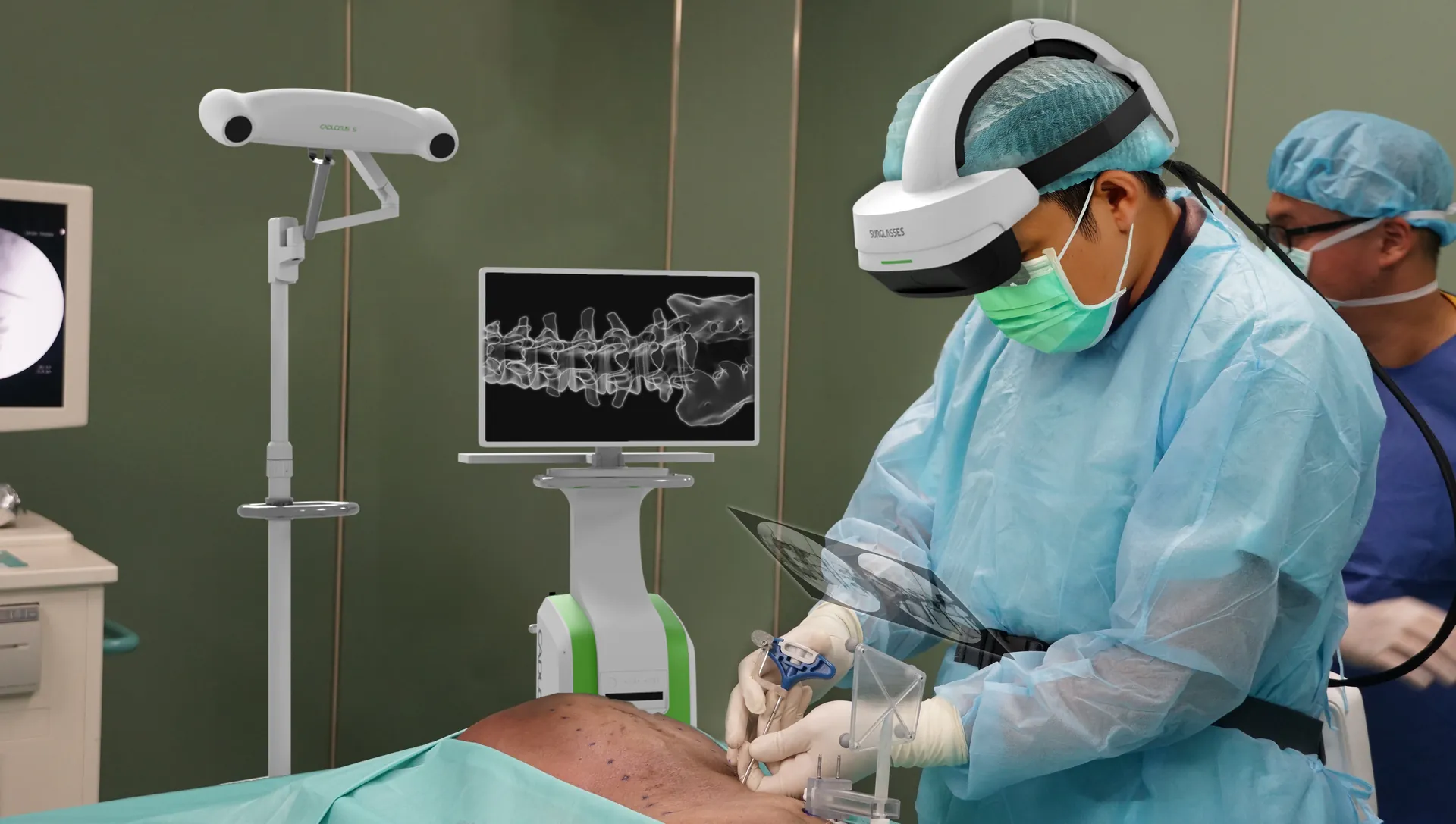
Surgical technology that keeps your eyes on the patient
Four systems that cover the surgical workflow — plan the case, navigate inside the body, and see the image without looking away from the operative field. Developed by a team that spent more than five years in operating rooms before anything shipped.
The lineup
Four systems, one operating room
Each one solves a different part of the same problem: the surgeon needs accurate spatial information, and needs it without turning away from the patient.
Caduceus S — AR Navigation
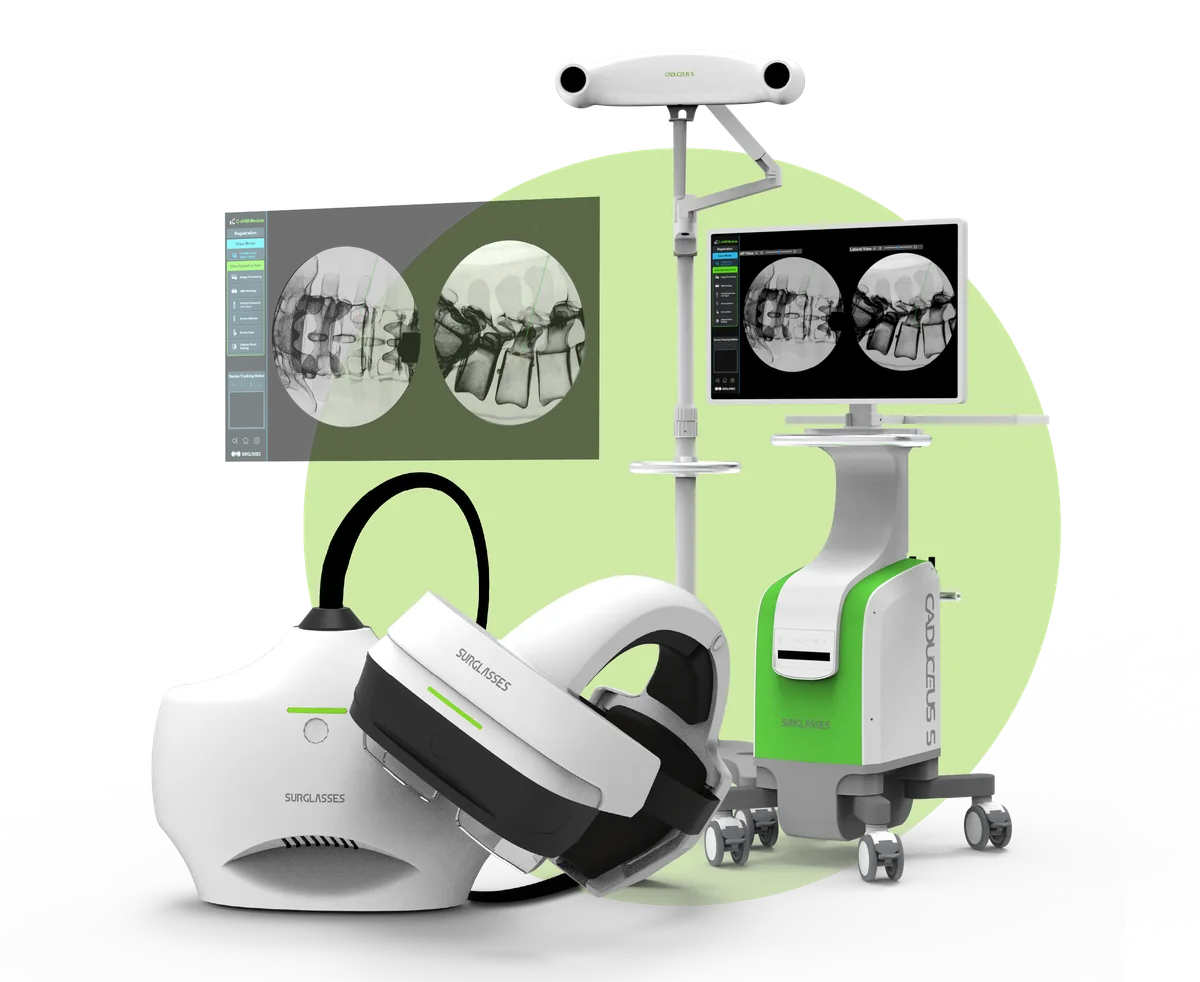
AR spine navigation. Navigation data is projected straight into the surgeon’s field of view, working like a GPS for the body — distance, direction and angle to the lesion, with a mean positional error under 2.0 mm in a cadaver study (FDA 510(k) K220554).
- No preoperative CT; 2 to 4 X-ray images per case
- Around 10 to 15 minutes of setup, against 30 to 40 for other systems
- Pedicle screws, scoliosis correction, vertebral fracture repair
Caduceus S — Navigation
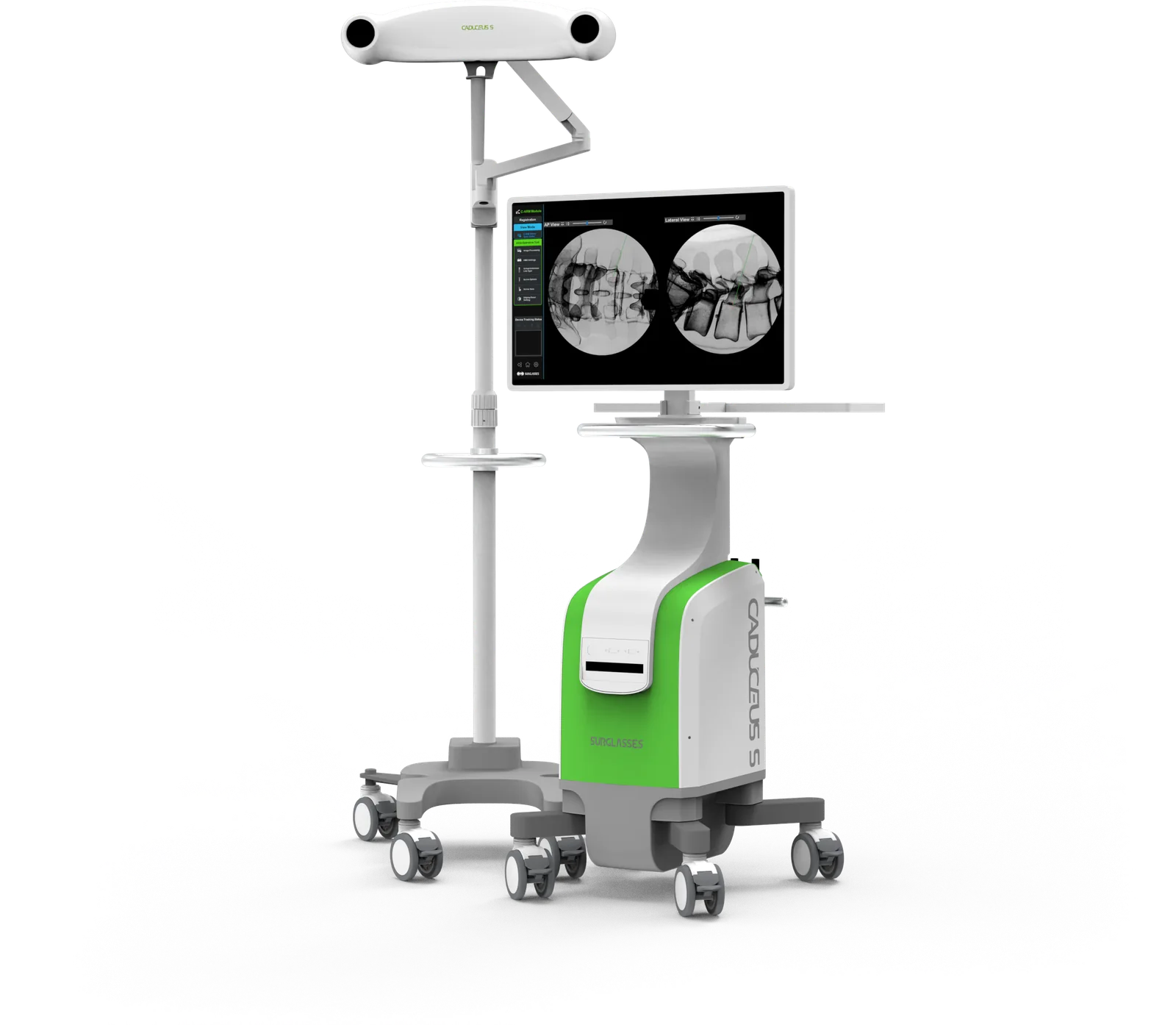
The same navigation platform, matched to the imaging your room already owns. Pick the module that fits — 2D C-arm, 3D C-arm, or intraoperative CT — and registration runs automatically from the scan.
- 2D C-arm module: navigation from a standard C-arm, for OSCs and ASCs
- 3D C-arm module: four or more levels, rotation, small curvatures
- Intraoperative CT module (O-arm) for deformity and scoliosis work
Foresee-X AR Glasses
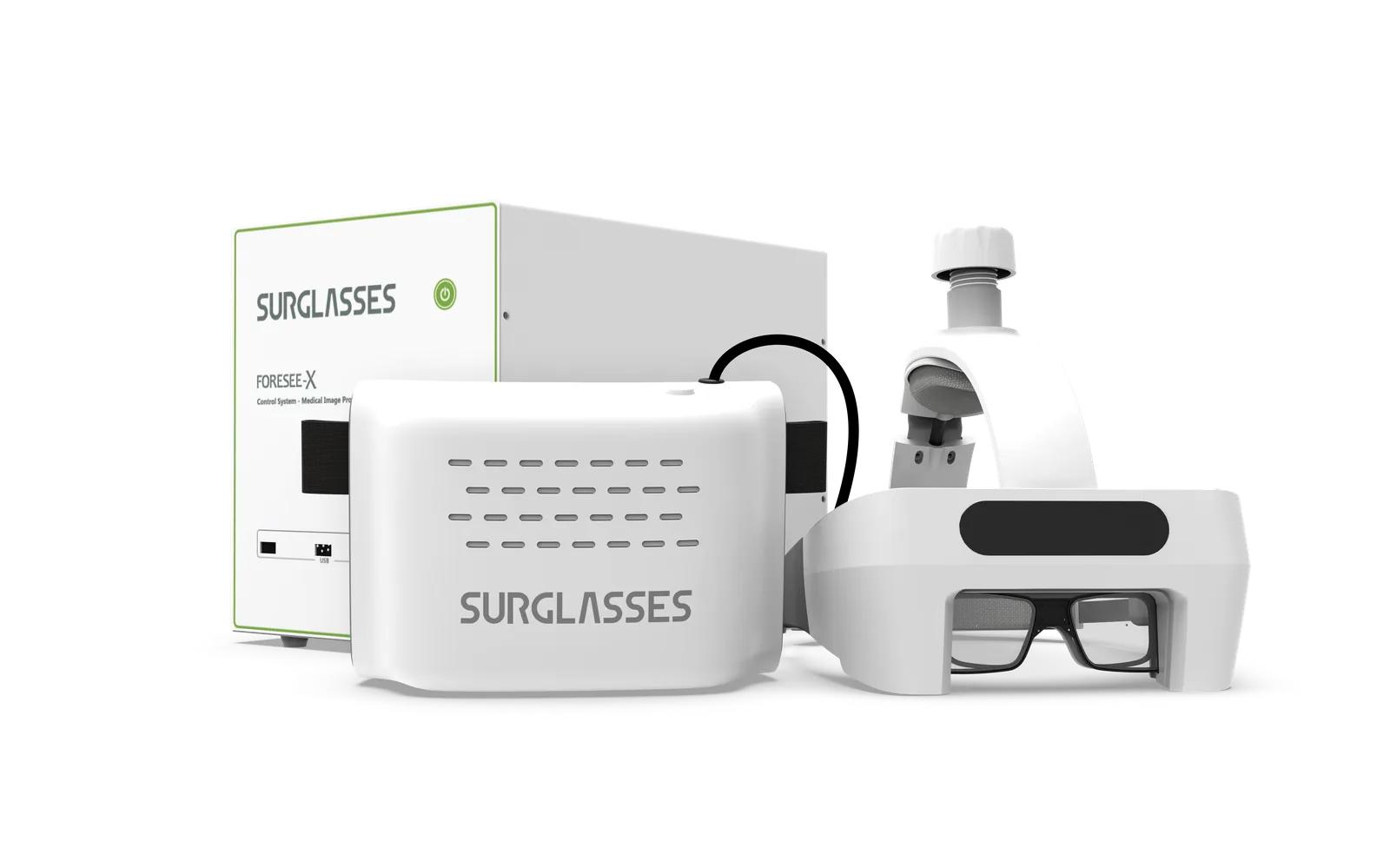
A wearable AR display for the images you already rely on. It streams fluoroscopy, ultrasound or endoscopy wirelessly onto a lightweight headset, so the view stays heads-up and hands-free.
- Works with C-arm, O-arm, laparoscope, endoscope and ultrasound
- No external monitor required; records and shares for tele-mentoring
- Backed by two peer-reviewed studies published in 2024
OOOPDS Surgical Planning
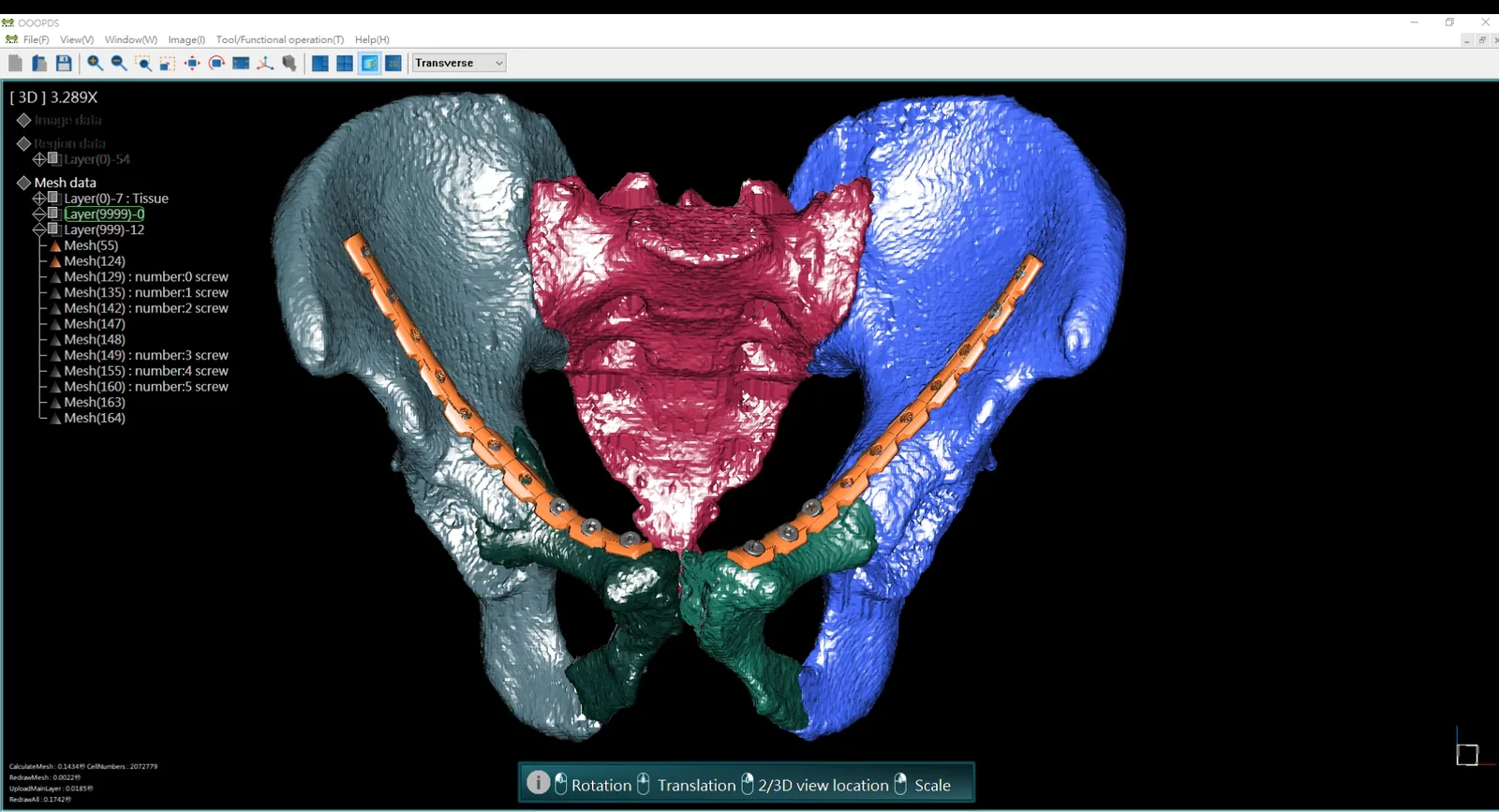
Orthopaedic planning software developed entirely in Taiwan. It loads DICOM, rebuilds it as a true-to-scale 3D model, and lets the screws, punctures and plates be simulated before the first incision.
- Pedicle screw, SI screw and spinal puncture path simulation
- Patient-specific bone plates, exported as .stl, .ply or .obj to print
- Orthopaedics, neurosurgery and dental implant planning
How they fit together
Plan it, navigate it, keep looking at it
The four systems are sold separately and each stands on its own — but they were designed around one continuous case.
Before the incision
OOOPDS turns the patient’s own CT or MRI into a 3D model, so screw diameter, length and trajectory are decided in advance — and a patient-specific plate can be 3D printed instead of bent by hand on the table.
Inside the body
Caduceus S registers the patient to live imaging and tracks the instrument against it, reporting distance, direction and angle to the target (mean positional error under 2.0 mm) — how deep the drill has gone, not just where it points.
Without looking away
Both AR products put the image in the line of sight instead of on a monitor across the room. Fewer head turns means better hand–eye coordination and attention that stays on the operative field.
Regulatory status
Cleared for clinical use
Every device below is a licensed medical device, manufactured under an ISO 13485:2016 quality management system certified by SGS.
Caduceus S
US FDA 510(k) clearance K220554 for the AR Computer Surgical Navigation System, plus a TFDA Class II licence in Taiwan, MOHW-MD-No. 008401, and Thai FDA import licence No. 66-2-3-2-0016533 issued in December 2023.
Foresee-X
CE marked as a Class I device under MDR (EU) 2017/745 for the European market, and licensed by the Taiwan Ministry of Health as a Class II medical device, MOHW-MD-No. 007801.
OOOPDS
US FDA 510(k) clearance K254214 for the medical image processing and planning software, plus a TFDA Class II licence in Taiwan, MOHW-MD-No. 007110.
See it for yourself
Find out which system fits your operating room
Tell us what imaging you already have and the procedures you run most, and we will show you the configuration that makes sense — online or on site.